
Jupiter - Soft tissue biopsies and ablations

*Medical Device Registration No.: NMPA 20253010073
Since its establishment, the company has focused on providing robot-based system for minimally invasive cancer treatments. The new generation robot-based soft tissue puncture and ablation system developed by AMIT is mainly used for minimally invasive percutaneous interventional ablations for liver cancers, which helps doctors to provide accurate treatment and improve patients' prognosis, especially for early-stage cancer patients. This system will fill the gap in the field of minimally invasive treatment product and method for liver cancer and meet the current unmet need for liver cancer treatment in China.
KEY DATA
Hepato-cellular cancer

368,000+
New cases of primary liver cancer
New cases of primary liver cancer across China in 2022
2nd
Ranking
Ranking of cancer mortality across China in 2020
390,000+
Death cases
Total liver cancer death cases across China in 2020

Surgical navigation software
- 3D image real-time fusion
- Intelligent surgical path planning
- What you see is what you get

Flexible force-controlled robotic arm
- Force-sensing sensitivity up to 0.1N
- Sensitive, accurate, and smooth

Accurate navigation
- Millimeter level accuracy
- Improve safety for surgeries
- Reduce patients' pain
AI assisted training system
related data
30%
Overall utilization rate
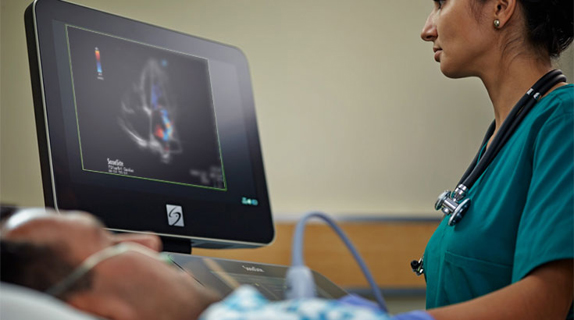
The rate of regional nerve block anesthesia is close to 30% of total anesthesia
110,000+
Number of Anesthesiologists
In 2021, there're approximately 110,000 Anesthesiologists registered in China
AI assisted training system for
standardized nerve block training

As the development and application of artificial intelligence technology in medical field grows continuously; Anesthesiology, as a discipline that involves multiple aspects of clinical care, could be benefit from the advances in artificial intelligence greatly. Thanks to the widespread of ultrasound in clinical applications, Ultrasound-guided nerve block technique has also seen rapid development. In clinical practice, it is important to provide a simple and effective training system to help trainees identify target nerves and surrounding tissues more quickly and accurately, which can effectively reduce unnecessary side effects during the learning stage. In order to develop an ultrasound-guided nerve block training system, we collected and labelled a large number of images to train an AI model, which can dynamically identify anatomic structure in certain ultrasound images.

AI model training
- Deep learning
- Character learning ability
- Image interpretation

Learning method
- Create learning system
- Practicing and training system
- Termly testing system
- Teaching-learning feedback system

Social benefits and economic benefits
- The rate of local nerve block anesthesia is close to 30% of total anesthesia
- In 2021, there're approximately 110,000 Anesthesiologists registered in China
KEY DATA
Anesthesia

30 million/year
Number of operations performed
In hospitals across China, the total number of nerve block anesthesia cases is approximately 30 million per year
200+ billion
Market volume
The estimated market volume of Anesthesia robots is approximately 18 billion. Meanwhile, the global interventional radiology market volume is around 200 billion.
Intelligent Anesthesia
assisting robot

The product's unique puncture navigation technology includes puncture path planning, smart interpretation for medical image and puncture needle trajectory. The puncture navigation system serves as a visualization tool to effectively monitor the entire puncture process in real time, which will enable the physician to easily complete the puncture process with the assistance of a guidance line. The puncture path planning process need to be done before the needle placement, helping the physician to anticipate the trajectory of the needle in advance, this will effectively avoid injuring important tissues and organs when placing needles. It also allows physician to simulate the process of inserting needle through the tissue, which enables general physician to perform difficult and complicated interventional procedures as a skilled physician can do.

Force-controlled puncture technology
- Puncture skills can be standardized and quantified

Precise puncture navigation technology
- Visible guidance line for doctors' reference

High accuracy robot controlling technology
- Millimeter level accuracy
- Adaptive puncture path planning
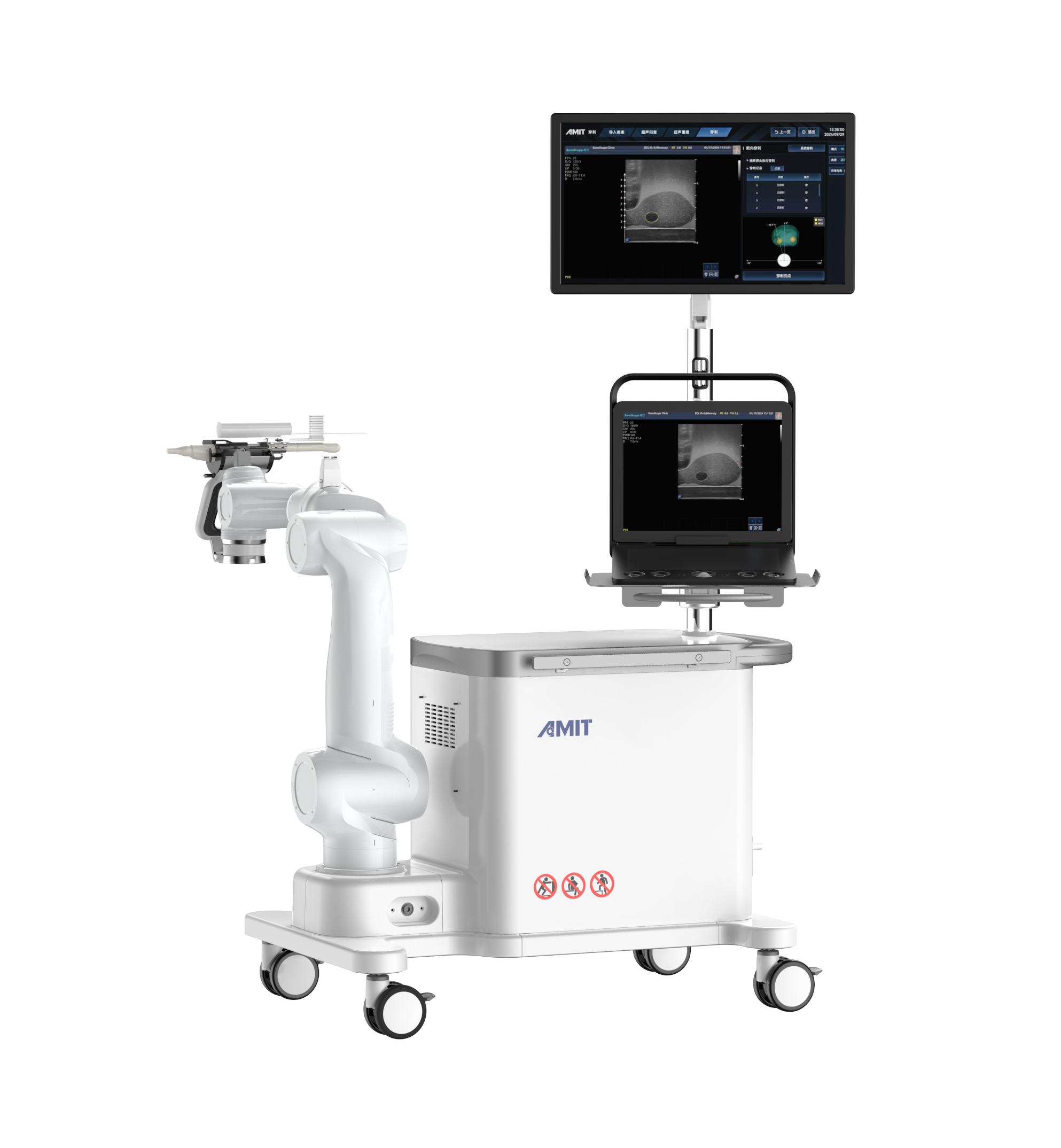
Mercury - Prostate biopsy navigation robot
*Medical Device Registration No.: NMPA 20253012743
A high-end medical device integrating MR-TRUS elastic registration and intelligent precise positioning. It adopts advanced robotic technology and image fusion algorithms to improve the accuracy and efficiency of prostate biopsy, reduce patient pain and complication risks, and provide strong support for early diagnosis and treatment of prostate cancer.
KEY DATA
Prostate cancer

134,100+
New cases in 2022
The fastest growing malignant tumor in China
1,414,200+
New prostate cancer cases
WHO-IARC 2020, global new cases
3rd
Ranking
7.3% of all malignant tumors globally in 2020
Surgical navigation software
- Prostate MRI and TRUS auto-segmentation
- Automatic 3D reconstruction, elastic registration
- Postoperative biopsy report generation
Flexible force-controlled robotic arm
- Dual-mode control: follow-up / micro-motion
- Force-sensing sensitivity up to 0.1N
- Sensitive, accurate, and smooth
Accurate navigation
- Real-time multimodal fusion guided biopsy
- Millimeter level accuracy
- Improve safety for surgeries
- Reduce patients' pain
Product safety and performance information: Mercury Product Safety and Performance Information